Flying With CBD: A Packing List That Survives the Security Tray
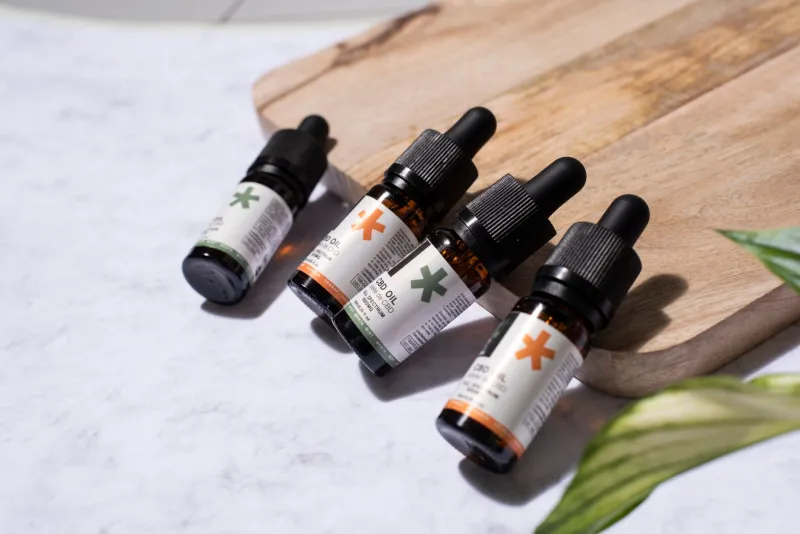
There's a particular kind of quiet panic that sets in the night before an early flight. Passport, charger, the vague worry that you've forgotten something obvious — and then the small bottle on the bathroom shelf. Does that go in the clear bag? Will someone want a word about it? Should it just stay home?
The short answer is that flying with CBD from a UK airport is usually uneventful. The longer answer is that it's uneventful if you pack it the way security actually thinks about luggage, rather than the way you think about your wellness routine. Those are two different things.
Start with what security is and isn't checking
Airport security staff at UK airports are looking at the physical properties of what's in your bag: size, shape, liquid volume, batteries, sharp things. They are not customs officers and they are not there to audit your supplement shelf. That distinction matters, because it tells you what to prioritise. A clearly labelled, correctly sized bottle causes far less friction than a perfect certificate tucked into an email you can't open at the belt.
CBD itself is legal to buy and carry in the UK when it comes from a licensed, tested source and sits under the trace-THC ceiling that consumer products are tested against. That's the legal backdrop — but the practical test at the airport is simpler: is it a liquid, is it under the limit, and can you explain what it is?
Oils are liquids. That's most of the job done
A CBD oil is a liquid, full stop. It doesn't matter that you take 0.3ml under your tongue or that the bottle is tiny. It goes in the clear bag.
The rule that catches people out is that it's about container size, not contents. A 100ml bottle with 15ml left in it is still a 100ml bottle. Most CBD oils come in 10ml or 30ml droppers, so in practice you're comfortably inside the limit — but if you've bought a larger bottle and planned to travel with the dregs, don't. That's the one that gets pulled.
A note on 2026: many UK airports have now moved over to next-generation security scanners, and some no longer enforce the old 100ml rule the way they used to. But rollout has been uneven, rules differ between airports, and it's not worth gambling your morning on it. Check your specific airport's guidance a couple of days before you fly, and pack as though the 100ml rule is still in force. If it turns out it isn't, you've lost nothing.
What goes in the bag, what goes in the cabin, what stays home
In the clear bag: your oil, in its original bottle. That's it. One bag per person, roughly 20cm by 20cm, at most UK airports.
In your main cabin bag, not the liquids bag: capsules, tablets and gummies. These are solids, and they don't need to be fished out at the belt. Keep them in their original tub or pouch, though — a handful of loose capsules in a sandwich bag is the sort of thing that invites a second look.
Cabin only, never the hold: anything with a lithium battery, which includes rechargeable vape pens. Single-use vapes are now banned in the UK anyway, so if you've got an old disposable rattling around in a drawer, it isn't coming with you.
Stays at home: the 200ml value bottle, the unlabelled sample someone gave you, the mystery gummy from a market stall with no ingredient list, and anything you can't find a batch number for. None of these are worth a conversation at 5am.
Labels quietly do the heavy lifting
If there is one thing that makes a security officer's job easier — and your morning smoother — it's a bottle that says what it is. Original packaging, readable label, brand name, batch number, strength in milligrams. That's the difference between "a small brown bottle" and "a CBD oil at 10%, here's the batch number."
It's worth screenshotting the certificate of analysis for your batch, too. Not because anyone will ask, but because the one time someone does, you'll be glad it's on your phone rather than buried in an email from March. A photo of the receipt does the same job if you've kept one.
And resist the urge to decant into a smaller, cuter bottle. Anything you transfer loses its label, its batch number and its provenance in one go. There are travel-size CBD oils for a reason.
The thirty seconds before the tray
Double-bag the bottle in a small zip pouch and keep it upright, because cabin pressure does odd things to dropper tops. Don't overstuff the clear bag — a bag that won't close is a bag that gets emptied onto a tray. And take it out before you reach the belt rather than after. A bottle discovered in a coat pocket at the last minute reads very differently from a bottle sitting neatly in the tray where it should be.
Keeping your routine steady, without the theatre
Count your days and take what you need, plus one spare. If you usually take your oil at 8am, aim to keep roughly that rhythm — but don't schedule a dose for the exact moment you're queuing for security if you'd rather be sharp. There's no prize for dosing on the move.
Time zones matter more than most people expect. A weekend in Dublin is barely a shift; a week in Lisbon isn't, either. But if you're crossing further, the sensible approach is to anchor your dose to your own routine rather than the local clock, at least for the first couple of days. And keep a note in your phone of what you normally take, so you're not doing mental arithmetic in a hotel bathroom at midnight.
Before you book, check the other end
UK rules are only half the story. Some countries treat CBD as a controlled substance regardless of how legal it is here, and "it's fine in Britain" is not a defence at a foreign border. Check the Foreign, Commonwealth and Development Office travel advice for your destination, and check the airline's own policy — they're usually aligned, but not always.
Domestic flights within the UK and to Belfast are the easy version of this. International is where a five-minute check earns its keep.
If someone does ask
Answer plainly. "It's a CBD oil — here's the label and the batch certificate." No speech, no lengthy explanation of your evening routine. Nine times out of ten that's the end of it, and the tenth time you'll be glad you packed the version with a label on it.
This is general information rather than legal or medical advice. Check your airport, airline and destination guidance before you travel.